Saudi Arabia’s next hospitality chapter will be defined by the breadth of its capital
Saudi Arabia’s next hospitality chapter will be defined by the breadth of its capital The theme of this year’s Future Hospitality Summit (FHS) Saudi Arabia, 'Where Opportunity Meets Capital', captures exactly where Saudi Arabia’s hospitality market is heading.
Analysis explores how Saudi hospitality investment is evolving from development-focused momentum to a sophisticated market matching diverse capital types with varied opportunity segments. In the lead up to the Future Hospitality Summit - FHS Saudi Arabia, taking place from 22-24 June 2026 at Mandarin Oriental Al Faisaliah, Riyadh, we asked several industry partners about what's next for hospitality investment in line with this year's event theme: "Where Opportunity Meets Capital."
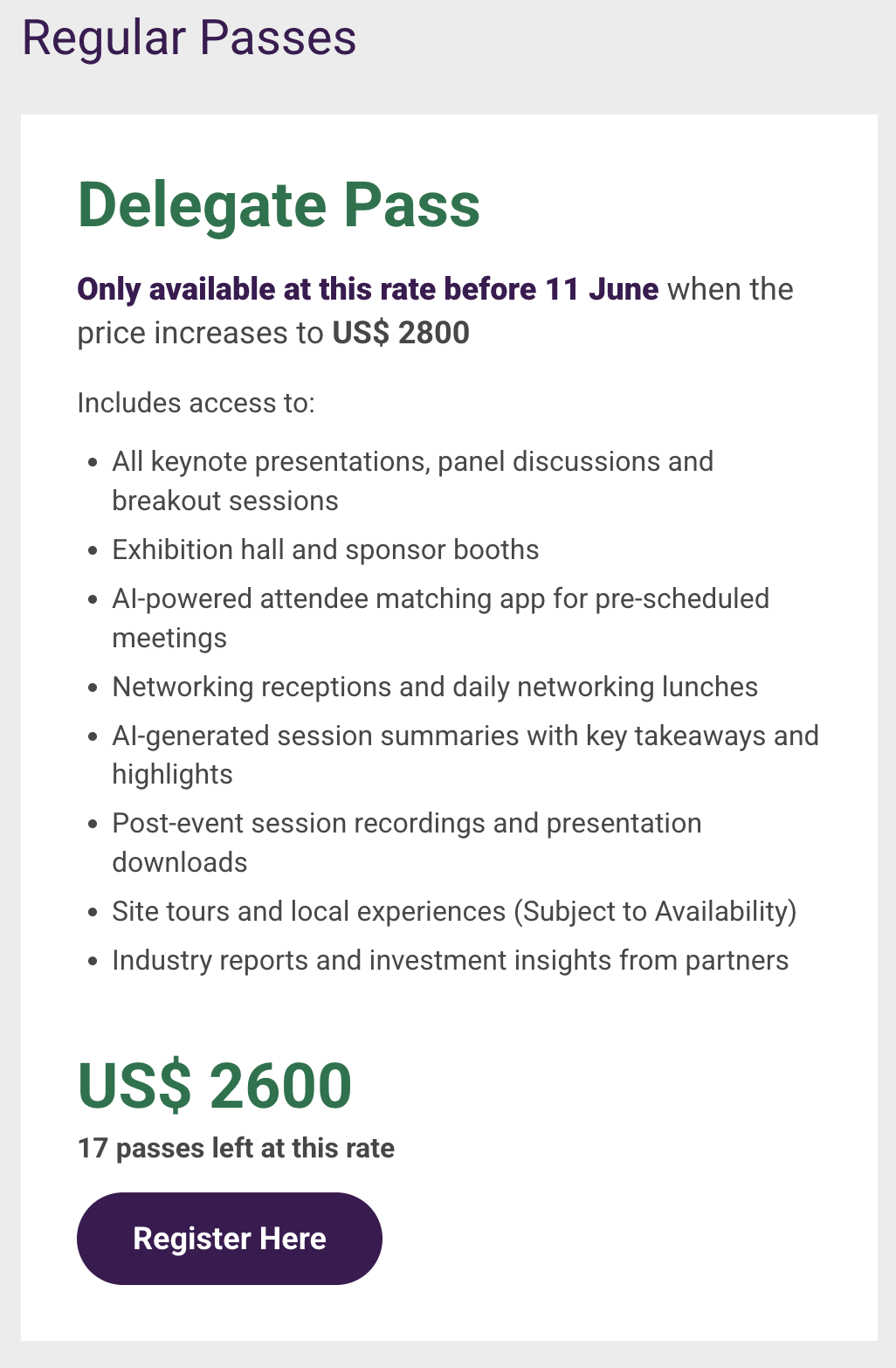
Delegate Pass available for US$ 2,800.00
Includes access to:
All keynote presentations, panel discussions and breakout sessions
Exhibition hall and sponsor booths
AI-powered attendee matching app for pre-scheduled meetings
Networking receptions and daily networking lunches
AI-generated session summaries with key takeaways and highlights
Post-event session recordings and presentation downloads
Site tours and local experiences (Subject to Availability)
Industry reports and investment insights from partners
Saudi Arabia’s hospitality market has reached an important turning point. For the last few years, the focus has been on ambition, scale, and pipeline. That made sense. The Kingdom needed to establish momentum, signal intent, and show the world the size of its tourism and hospitality vision. Now the conversation is becoming more sophisticated. The question is no longer whether opportunity exists in Saudi Arabia. It clearly does. The more relevant question is what kind of opportunity we are talking about, what kind of capital it requires, and which investors are best positioned to unlock it. That is because hospitality investment in Saudi Arabia is not one single opportunity. It is a broad and increasingly varied landscape.
A luxury resort on the Red Sea is a very different proposition from a hotel in Riyadh or Jeddah. A religious tourism asset in Makkah or Madinah operates differently from a mixed-use development in an emerging secondary city. Branded residences, serviced apartments, upper-upscale hotels, midscale properties, lifestyle concepts, and conversion opportunities all attract different investor profiles and require different return expectations, timelines, and levels of operational understanding. This is where the market is becoming more interesting. Opportunity varies, and investors vary too. Today, the investor base in Saudi Arabia remains largely domestic and GCC-led, and that is normal. In fact, it is one of the strengths of the market. Saudi and regional investors often have the highest conviction early in a market’s growth cycle. They understand local demand, they know how to assess long-term national transformation, and they are often more comfortable investing ahead of full market maturity. They do not need to wait for every data point to be perfect before acting. We saw a similar evolution in other Gulf markets, particularly in the UAE. In the earlier stages, local and regional capital played the leading role. Over time, as the market deepened, regulation evolved, performance became easier to benchmark, and exit routes became more visible, a broader international investor pool followed. Saudi Arabia is on a similar path. It is still largely Saudi and GCC-centric today, but that will change as the market matures further and becomes easier for a wider range of investors to access, understand, and underwrite. What is already clear is that the capital base behind hospitality in Saudi Arabia is expanding.
At the top of the spectrum are sovereign wealth funds and other major state-backed investment platforms. Their contribution goes far beyond funding. They create confidence, set direction, anchor large-scale development, and accelerate the kind of destination creation that private capital alone would struggle to deliver in the early phases. Their role has been essential in building the foundations of the sector. Alongside this, public-private models continue to play an important role. Hospitality often sits at the intersection of infrastructure, urban development, tourism strategy, and private enterprise. That makes partnership structures especially relevant. In many cases, they allow long-term strategic priorities to align with commercial discipline in a way that benefits both destinations and investors.
At the same time, private capital is becoming more active and more nuanced. This includes family offices, high-net-worth individuals, private investors, and entrepreneurial developers who can move quickly and identify gaps in the market. These investors are often well placed to pursue opportunities that do not always sit at the centre of the biggest national headlines, especially in secondary cities, niche concepts, conversion projects, and segments where flexibility matters as much as scale. Real estate developers are also playing a bigger role in shaping hospitality investment. More and more, hotels are not being viewed only as standalone assets. They are being considered as strategic components within broader master plans and mixed-use developments. A hotel can help activate a destination, strengthen a residential offering, enhance retail value, and support placemaking. In that sense, hospitality becomes both an asset class and a value creator for the wider development.
Another important shift is the rise of more structured investment vehicles. REITs in Saudi Arabia are becoming more relevant, more funds are being created, and capital platforms are beginning to diversify. This is significant because it points to a more mature investment environment. Institutional capital looks for structure, governance, and clarity. It wants credible entry points and, equally importantly, visible exit routes. That is why I believe one of the most important developments ahead is Saudi Arabia’s evolution into a transactions market.
For some time, the dominant story has been development, new destinations, new supply, and future openings. The next phase will be broader than that. We will see more acquisitions, more joint ventures, more conversions, more recapitalizations, and more deal activity across different parts of the market. That is a positive sign. A healthy hospitality market is not only one where assets are built. It is one where assets are bought, sold, repositioned, partnered, and refinanced. Transactions create benchmarks. They improve transparency. They support valuation discipline. And they make markets more investable.
Saudi Arabia’s hospitality story remains one of the most compelling in the world today. But the next chapter will not be defined only by the volume of opportunity. It will be defined by the diversity of that opportunity, the increasing sophistication of its investors, and the market’s ability to match the right capital to the right asset at the right moment. That is how markets move from momentum to maturity. And that is where the real long-term opportunity lies. Read Original